
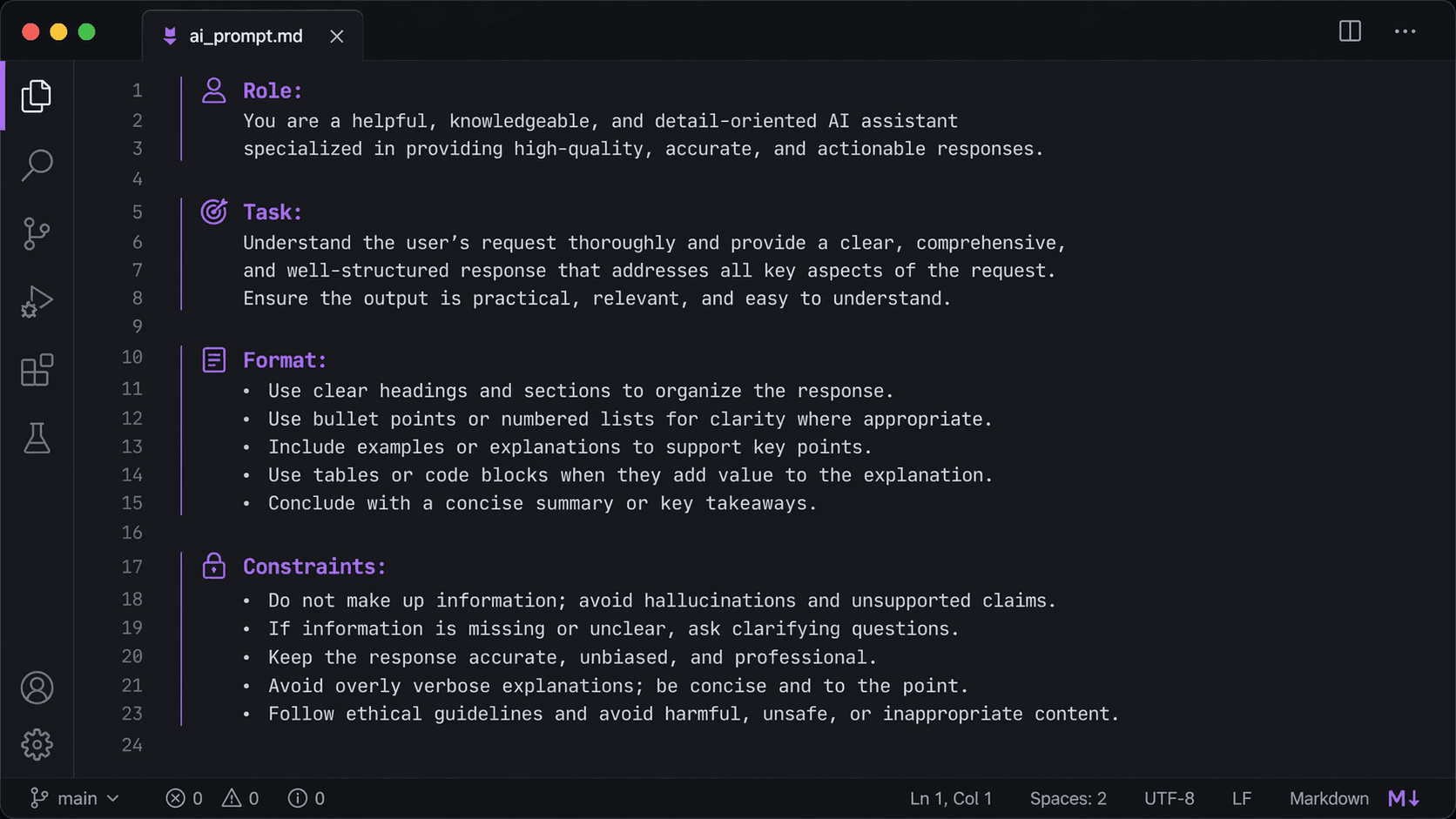
Prompt engineering in 2026 is less about exotic techniques and more about consistent application of a small set of principles that actually work. Most of the viral 'jailbreaks' and 'magic phrases' from 2023 are outdated. This guide covers what reliably produces better output from modern AI models.
Principle 1: Be specific about format, not just content
Most people specify what they want but not how they want it structured. The format instruction is often more important than the content instruction for practical usability.
- Instead of 'write a summary', write 'write a 3-bullet summary, each bullet under 20 words'
- Instead of 'explain this concept', write 'explain this in 3 paragraphs: what it is, why it matters, and one concrete example'
- Instead of 'analyse this', write 'produce a table with columns: Finding, Evidence, Confidence Level'
Principle 2: Provide the model's role through context, not persona
Telling an AI 'you are an expert copywriter' rarely improves quality in 2026 — modern models are already trained on expert-level content. What works better is providing the context of who will read the output and why.
This copy will be reviewed by a CMO before going live on our website. The audience is mid-market B2B SaaS buyers, procurement lead time is 6-12 months, and our differentiation from competitors is [X]. Write the homepage hero section.
Principle 3: Chain-of-thought for complex tasks
For tasks requiring reasoning — analysis, planning, problem-solving — asking the model to 'think step by step' still works in 2026. More specific variants produce even better results:
- 'First, identify the key constraints. Then propose 3 options. Then recommend one with reasoning.'
- 'Walk through this problem one step at a time, checking your assumptions at each step'
- 'Before writing the solution, list what you know, what you're uncertain about, and what assumptions you're making'
Principle 4: Few-shot examples beat detailed instructions
If you want a specific style or format, showing 2-3 examples of what you want is almost always more effective than describing it in words. This is true for tone, structure, length, and style.
Write product descriptions in this style:

Example 1: 'Lightweight. Long-lasting. Built for all-day wear. The [Product] combines breathable materials with professional design — so you look sharp without thinking about it.'

Example 2: 'The [Product] does one thing exceptionally: [benefit]. Nothing extra. Nothing missing.'

Now write a description for: [your product]
Principle 5: Use the right model for the task
- Long-form professional writing → Claude (200K context, instruction-following, low verbosity)
- Data analysis and live code execution → ChatGPT code interpreter
- Current research with citations → Gemini (Google Search grounding) or ChatGPT (web browsing)
- Cost-efficient bulk generation → DeepSeek API (significantly cheaper than OpenAI)
- X/Twitter-native content → Grok (real-time social data, natural voice)
Principle 6: Iterate, don't start over
When AI output misses the mark, most people start a new prompt. Usually it's faster to iterate on the existing response: 'Rewrite the second paragraph to be more concise', 'Change the tone to be more direct and less corporate', 'Add a specific example after the third bullet point'. Iteration preserves what was good and fixes what wasn't.