
Elon Musk launched xAI in 2023 and built Grok as a direct challenge to OpenAI — the company he co-founded and then publicly left. By 2026, both models have matured significantly, and the gap between them is no longer about raw intelligence. It's about what you actually need an AI to do.
We tested Grok 3 and ChatGPT (GPT-4o) side by side on writing, coding, reasoning, and real-time research. This is the full breakdown — including where each model genuinely wins, where they're tied, and who should pay for which.
Grok vs ChatGPT: at a glance
| Grok 3 | ChatGPT (GPT-4o) | |
|---|---|---|
| Price | $8/mo (X Premium) | $20/mo (Plus) |
| Free tier | Limited — grok.com | GPT-4o with usage caps |
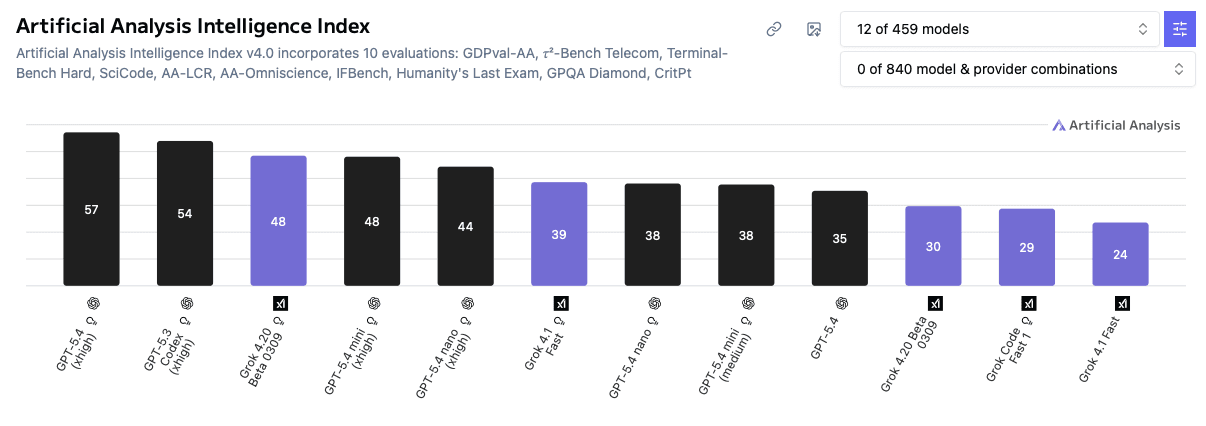
| Raw intelligence | Tied on major benchmarks | Tied on major benchmarks |
| Real-time info | Live X/Twitter feed | Bing search (slight lag) |
| Image generation | Basic | DALL-E 3 (high quality) |
| Code interpreter | No | Yes — runs Python live |
| Voice mode | Basic | Advanced Voice Mode |
| Memory | No | Yes — persists across sessions |
| Custom integrations | None | Thousands of Custom GPTs |
| Context window | 131K tokens | 128K tokens |
| Best for | X users, real-time social data | Professional workflows, data work |
What is ChatGPT?
ChatGPT is OpenAI's flagship conversational AI, launched in November 2022 and now running on GPT-4o with the newer o3 reasoning model available on Plus. It's the most-used AI assistant in the world, with over 200 million weekly active users as of 2026.
ChatGPT's core strength is its ecosystem. In addition to the chat interface, it ships with DALL-E 3 image generation, a live code interpreter that runs Python in-browser, persistent memory across sessions, Advanced Voice Mode for real spoken conversations, and thousands of Custom GPTs built by third-party developers.
- Models: GPT-4o (flagship), GPT-4o mini (fast/cheap), o3 (deep reasoning)
- Image generation: DALL-E 3 — describe an image and get it in seconds
- Code interpreter: paste a CSV, run analysis, plot charts, iterate — all inside chat
- Memory: remembers your preferences, projects, and context across sessions
- Voice mode: real-time spoken conversations with natural interruption support
- Custom GPTs: thousands of third-party assistants for specific tasks
- Context window: 128K tokens
- Price: free tier (GPT-4o, usage-capped) or $20/month Plus
What is Grok?
Grok is xAI's AI assistant, built by Elon Musk's team with one structural advantage that ChatGPT doesn't have: native, real-time access to the full X (formerly Twitter) feed. Grok 3, the current flagship, uses a mixture-of-experts architecture and matches GPT-4o on most benchmark tests.
Grok's personality is deliberately more casual and less filtered than ChatGPT — it's willing to engage with edgier topics, uses humor, and reads more like an internet-native voice. That's a feature for some users and a liability for others, especially in professional contexts.
- Models: Grok 3 (flagship), Grok 3 mini (faster, lighter)
- Real-time X/Twitter: reads live posts, trends, and breaking news directly
- DeepSearch: live web search mode for current information retrieval
- Context window: 131K tokens
- Personality: witty, more informal, less filtered than ChatGPT
- Platform: available at grok.com or via X Premium subscription
- Price: limited free tier; full access via X Premium at $8/month
- No code interpreter, no image generation at scale, no third-party app store
Reasoning and problem solving
Both models handle multi-step reasoning well, but they approach it differently. ChatGPT walks through problems methodically — it structures the answer, acknowledges trade-offs, and formats output so it's immediately usable. Grok reaches the right answer but takes detours: it editorializes, adds humor, and explores tangential angles.
For professional analysis, financial modeling, or structured planning — ChatGPT's focused approach wins. For open-ended brainstorming or ideation, Grok's willingness to range widely can actually surface ideas that ChatGPT's more conservative style would skip.
Coding and technical tasks
On raw code generation benchmarks (HumanEval, SWE-bench), Grok 3 and GPT-4o are essentially tied in 2026. Both produce clean Python, TypeScript, Go, and Rust for standard tasks. For a single function or code review, you won't notice a meaningful quality difference.
The gap opens the moment you need to run code. ChatGPT's built-in code interpreter executes Python live in the browser — paste a CSV, write analysis scripts, see the output, fix errors, plot charts, all in the same session. Grok has no equivalent. You generate the code, copy it, run it somewhere else, manually debug.
- Pure code generation: tied — both produce solid output for standard tasks
- Interactive development: ChatGPT wins — code interpreter is irreplaceable for data work
- Data analysis and visualisation: ChatGPT only — Grok can't execute or plot
- Debugging: ChatGPT can iterate on errors in the same session; Grok cannot
- Algorithm brainstorming: Grok holds its own — good for alternative approaches and fast prototyping
Writing and creativity
ChatGPT produces more polished, professionally reliable writing. It follows style briefs precisely, maintains voice consistency across long documents, and rarely drifts from the brief. The weakness: unconstrained, it defaults to slightly formal, slightly safe output.
Grok writes more like a person who lives on the internet — it uses cultural references, handles humor naturally, and produces casual copy that doesn't feel AI-generated. For social media content, brand voices that lean edgy or conversational, memes, and informal communication, Grok is genuinely better. For business writing, reports, client communications, and long-form content, ChatGPT is the more reliable choice.
Real-time information: Grok's biggest edge
This is the one area where Grok has a structural advantage that ChatGPT can't fully replicate. Grok reads the full X/Twitter firehose in real time — every public post, as it's posted. Ask what people are saying about a breaking story right now, what's trending in a niche community, or what a specific account posted this morning, and Grok answers from live data.
ChatGPT uses Bing search, which is excellent for indexing web pages — but it lags behind fast-moving social content by hours, and it simply can't search within X posts the way Grok can natively.
Who this matters for: journalists, social media managers, crypto and finance professionals (where X is the primary price-discovery channel), trend researchers, and anyone monitoring brand mentions in real time. For everyone else, ChatGPT's web browsing handles current events well enough.
Image generation
ChatGPT wins here without contest. DALL-E 3 is built directly into the chat interface — describe an image, iterate with follow-up text prompts, generate multiple variations. The quality is high and the control is intuitive. Grok has basic image generation but it's a different tier of quality and offers far less iterative control. If image generation is part of your workflow, ChatGPT is the only serious option.
Pricing: what you actually pay
Grok is available free (limited) at grok.com, or with full Grok 3 access via X Premium at $8/month. ChatGPT has a free tier with usage-capped GPT-4o access, and ChatGPT Plus at $20/month which includes GPT-4o, o3, DALL-E 3, code interpreter, and memory.
| Plan | Grok | ChatGPT |
|---|---|---|
| Free tier | Limited access — grok.com | GPT-4o with usage caps |
| Paid entry | $8/mo — X Premium | $20/mo — ChatGPT Plus |
| What's included | Full Grok 3 + X integration | GPT-4o, o3, DALL-E 3, code interpreter, memory |
| Best value if... | Already an X subscriber | Starting fresh, need full features |
The honest take: if you already pay for X Premium, Grok is a capable AI assistant at zero marginal cost. If you're comparing them purely as AI tools from scratch, ChatGPT Plus offers significantly more per dollar.
Which AI should you use?
| Use case | Best choice | Why |
|---|---|---|
| Professional writing & docs | ChatGPT | Follows briefs precisely, reliable tone, consistent output |
| Data analysis & visualisation | ChatGPT | Code interpreter runs Python live — Grok has no equivalent |
| Image generation | ChatGPT | DALL-E 3 built in; Grok's image gen is basic |
| Breaking news & social trends | Grok | Live X/Twitter feed is its core structural edge |
| Social media content | Grok | Natural internet voice; less AI-sounding for casual posts |
| Crypto / finance research | Grok | X is where price moves happen first — Grok reads it live |
| Already pay for X Premium | Grok | Full Grok 3 at no extra cost |
| Enterprise / compliance use | ChatGPT | Three years of governance track record vs xAI's early stage |
| Starting fresh, general use | ChatGPT | More features, stronger ecosystem, better value at $20/mo |
The verdict
For most people, ChatGPT is the better default. It has a larger feature set, a more mature ecosystem, and three years of production reliability. The $20/month price is higher, but you're getting DALL-E 3, a live code interpreter, memory, and voice mode — none of which Grok offers at any tier.
Grok is worth using — or switching to — if you work in journalism, social media, crypto, or finance where live X/Twitter access is genuinely valuable. It's also a no-brainer if you already pay for X Premium, since you get a capable Grok 3 model at zero additional cost.
The models are matched on raw intelligence. The features and ecosystem are not.